

Abstract: The most common and easy way to evaluate mutagenicity of environmental samples is the Salmonella/microssome assay. It uses with a set of strains of Salmonella bacteria in combination with a metabolic activation system able to detect different classes of chemicals. The Microplate Agar (MPA) is a miniaturized version of the Salmonella/microssome assay that requires 10 to 100 times less quantity of sample in comparison to other protocols. The bacteria YG1041 has been the most sensitive strain to detect mutagenicity of aerosol samples and it is also very sensitive to substituted polycyclic compounds such as nitro PAHs. The atmosphere of the Metropolitan Area of São Paulo is often affected by great quantities of particulate matter from different sources. In 2019, particulate matter of atmospheric samples (PM2.5) were collected from 7 sites with different sources of pollution and their organic extracts were tested using the Microplate Agar (MPA) due to the limited quantity of sample available for testing (1 to 3 mg of PM 2.5). The extracts were completely dried and resuspended in dimethyl sulfoxide (DMSO) to be tested in concentration-response experiments without and with exogenous metabolic activation (rat liver S9 5%, Phenobarbital/5,6-Benzoflavone induced, Moltox®) with the strain YG1041. Data were statistically analyzed using ANOVA/Tukey followed by a linear regression. All samples were mutagenic showing a clear concentration response (p<0,05). Results were expressed in the minimum effective concentration able to double the number of revertants (MEC2) in ng of particulate matter (PM2.5) per μL. The lower this number, more mutagenic is the sample. Samples were more mutagenic without S9 than with S9. Potencies varied from 1.74 ng PM2.5 (SPA29) to 61.63 ng PM2.5 (SPA33) without S9 (Figure 1A). With S9, they varied from 23,74 ng PM2.5 (SP29) to 180.81 ng PM2.5 (SPA13) (Figure 1B). The combination of the miniaturized protocol of the Salmonella/microssome assay (MPA) in combination with the YG1041 was effective in the detection of the mutagenicity of the aerosol samples using extract from only 1 mg of PM2.5. This approach can be an important tool to monitor the mutagenicity from when low quantities of atmospheric PM2.5 are available for testing.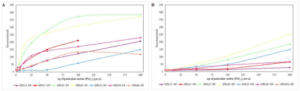
Figure 1. Concentration-response curves of the seven organic extracts of aerosol samples collected in São Paulo using the miniaturized version of the mutagenicity Salmonella/microssome assay (MPA) with strain YG1041 in the absence (A) and presence (B) of metabolic activation (S9).
Keywords: Ames test, nitro compounds, HPAs, metabolic activation.
June 6 @ 16:30
16:30 — 18:00 (1h 30′)
Lobby
Gabriely F. Groto Militão (Universidade Estadual de Campinas – Brazil)