
Abstract: The Amazon Tall Tower Observatory (ATTO) is a research facility in central Amazonia, approximately 150 km northeast of Manaus, Brazil. It consists of two 80 m towers and a 325 m tower and is designed to monitor the region’s climatic, biogeochemical, and atmospheric conditions over the long term. The site’s location in a pristine rainforest region makes it an important resource for studying the impacts of human-made and climate change-related forest perturbations. By employing source apportionment techniques and thermodynamic modeling, we aim to indicate the origins of atmospheric aerosols, differentiating them between the most relevant sources. For aerosol sampling on nuclepore filters, a Thermo Scientific PM2.5 aerodynamic cut inlet sampler with a flow rate of 16.67 LPM was employed at an elevation of 42 meters at the ATTO tower. The filters underwent Energy Dispersive X-ray Fluorescence Spectrometry (EDXRF) to quantify the concentration of chemical elements present in aerosol particle-containing samples. Simultaneously, measurements were performed with the Aerosol Chemical Speciation Monitor (ACSM) Instrument. Three distinct aerosol peaks in the elemental aerosol concentration were observed in Figure 1. The first and second peaks between March and May are associated with the long-range transport of Saharan dust and the western and central African biomass-burning aerosols, as observed in previous studies. The peaks are characterized by a high presence of K, Si, Ca, and Fe. The third peak is characteristic of the dry season in the Amazon rainforest between August and October, with strong particulate emissions related to local and regional biomass burning. It was possible to estimate, with the thermodynamic model ISORROPIA, that the main solid species in the aerosol phase were K2SO4 and CaSO4, with an increase of these species during the dry season, suggesting that they may be linked with biomass burning. Positive Matrix Factorization (PMF) was used for source apportionment, and a four-factor solution presented the best result with well-interpreted factors. Factor 1 was characterized by biomass-burning-related species such as K, Na, and BC and some other carbonaceous species fractions. Factor 1 was the second most abundant. Factor 2 represented the major fraction of PM2.5 (38%) and presented loadings of secondarily formed species as NH4 + , NO3 – , SO4 2- . The presence of Organic contribution is likely related to the local formation of secondary organic aerosol. Factor 3 was loaded with soil resuspension-related species, such as Al, Si, and Fe, although it also presented V, found in oil burning and industrial sources, likely associated with the site’s diesel-powered generator. Factor 4 presented loadings of P, and is attributed to biogenic sources. Therefore, this study at the Amazon Tall Tower Observatory revealed a seasonal increase in K2SO4 and CaSO4 aerosols, with Positive Matrix Factorization identifying four distinct sources, including biomass burning, secondary organic aerosol formation, soil resuspension, and biogenic emissions. These findings contribute crucial insights into the aerosol composition and sources in the central Amazon Basin, informing climate research and sustainable development efforts in the region.
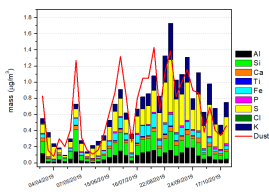 Figure 1. Seasonal variation of elemental chemical concentration observed in PM2.5 at the ATTO site in 2019.
Keywords: Particulate matter, receptor model, positive matrix factorization, ATTO site, central Amazon.

June 6 @ 10:10
10:10 — 10:25 (15′)
Room 3
Marco Aurélio de Menezes Franco (IAG/USP – Brazil)