
Abstract: The Metropolitan Area of São Paulo is often affected by high particulate matter levels due to the influence of its large vehicular fleet and pollution events are more common during drier periods of the year due to the influence of the increase of biomass burning events and less favorable meteorological conditions for pollutant dispersion. Polycyclic aromatic hydrocarbons (PAHs) in particulate matter have been associated with mutagenic properties. In 2019, an intensive campaign was performed in the drier months of the year (June to September) with a high-volume sampler (Hi-Vol), collecting fine particulate matter (PM2.5). Organic extracts were obtained after solvent extraction and polycyclic aromatic hydrocarbons (PAHs) were determined with a Gas Chromatograph coupled to a Mass Spectrometer (GC/MS). In order to study which particulate matter sources are more associated with mutagenic effects, some samples were selected as representative of specific particulate matter sources (secondary formation, vehicular exhaust and non-exhaust, industrial and biomass burning) and tested for mutagenicity through Salmonella/microsome assay in the miniaturized version, microplate agar (MPA), without and with metabolic activation (rat liver S9 5%,Phenobarbital/5,6-Benzoflavone induced). The SPA13 sample presented the lowest mutagenic potency (inverse of the minimum effect concentration: 1/MEC2) (Figure 1) and was associated with secondary formation by the receptor model. The SPA29 sample presented the highest mutagenic potency and was characterized by the influence of biomass burning. Despite the different mutagenic potencies, these samples present similar concentrations of PM2.5, benzo(a)pyrene (BaP), and theoretically calculated mutagenicity (BaP-MEQ), and carcinogenicity (BaP-TEQ). Furthermore, correlations were not found between mutagenicity results and PAHs or BaP-MEQ, and the increase in the observed concentrations of PAHs was not related to higher mutagenicity of the samples, suggesting the effect of other not determined species in the study or a complex interaction of different chemical species in the extract. When the experiment is performed with metabolic activation (+S9), differently from what is observed for the other samples, SPA33 presents an increase in mutagenicity which may be related to relatively lower effects of oxy- and nitro-PAHs in the experiment without activation (Figure 1A). For the assays with S9, the samples with lower mutagenicity potencies (SPA13, SPA15, and SPA64) were often related to high PM2.5 concentrations (above 30 μg m-3 ), while SPA33 presented the second highest potency and was associated with relatively low PM2.5 concentration (15 μg m-3 ), suggesting that higher PM2.5 concentrations not always are associated with higher mutagenicity.
(A)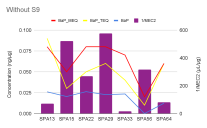 (B)
(B)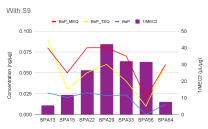
Figure 1. BaP-MEQ, BaP–TEQ, BaP (ng per μg of PM) concentrations in Y1 and mutagenic potencies (1/MEC2 in μg of PM) without (A) and with metabolic activation (+S9) (B).
Keywords: Polycyclic aromatic hydrocarbons, particulate matter, Salmonella/microsome assay, microplate agar, YG1041.
June 6 @ 16:30
16:30 — 18:00 (1h 30′)
Lobby
Guilherme Martins Pereira (USP – Brazil)