
One Day Training – UFES
Explore the applications of receptor modeling techniques such as Chemical Mass Balance (CMB) and Positive Matrix Factorization (PMF) in particulate matter source apportionment. Learn how these models are used to identify and quantify pollution sources using chemical composition data of atmospheric particles. Understand how CMB and PMF support air quality studies and contribute to more effective environmental management and regulatory decision-making.
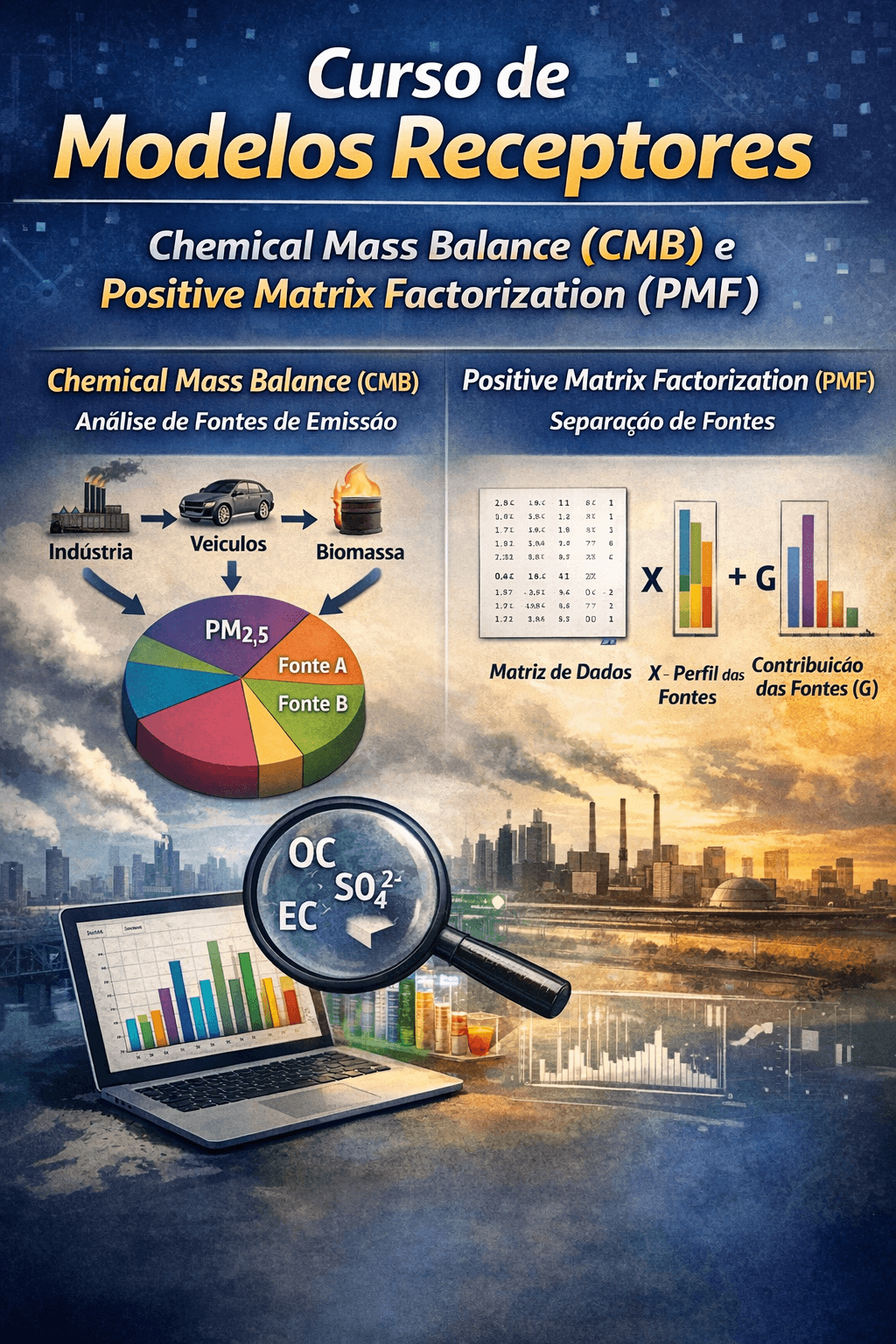
Training Description
Chemical Mass Balance (CMB) e Positive Matrix Factorization (PMF)
This 8-hour intensive course provides a focused introduction to receptor modeling techniques applied to particulate matter. The content is centered on the conceptual and methodological foundations required to understand and interpret source apportionment studies involving PM₂.₅, PM₁₀, total suspended particles (TSP), and sedimentable particles.
The course presents the theoretical principles of Chemical Mass Balance (CMB) and Positive Matrix Factorization (PMF), with emphasis on their application to particulate chemical composition data, including elemental carbon (EC), organic carbon (OC), inorganic ions, trace elements, and crustal material. Special attention is given to the differences in behavior and characterization of fine particles, coarse fractions, TSP, and sedimentable particles, particularly in urban and industrial environments.
Key topics include model assumptions, input data requirements, treatment of uncertainties, source profiles, interpretative strategies, and limitations of each approach. As this is a short-format course, the emphasis is on conceptual understanding and critical analysis of results rather than hands-on computational exercises.
By the end of the course, participants will be able to critically evaluate receptor modeling studies focused on particulate matter and understand how these tools support air quality management and regulatory decision-making.
Who should attend the course?
This course is designed for professionals, researchers, and graduate students working in the field of air quality and atmospheric sciences who seek a solid conceptual understanding of receptor modeling applied to particulate matter.
It is particularly suitable for:
- Environmental engineers and atmospheric scientists involved in air quality assessment and source apportionment studies.
- Researchers analyzing chemical composition data of PM₂.₅, PM₁₀, total suspended particles (TSP), or sedimentable particles.
- Professionals from environmental agencies responsible for monitoring programs and regulatory evaluations.
- Consultants and technical staff engaged in emission control strategies and environmental impact assessments.
- Graduate students in environmental engineering, atmospheric sciences, chemistry, or related disciplines who require foundational knowledge of CMB and PMF methodologies.
The course is appropriate for participants seeking to strengthen their theoretical understanding of receptor models and to critically interpret results from particulate matter source apportionment studies.

What you’ll learn
In this course, participants will gain a solid understanding of the fundamentals of receptor modeling applied to particulate matter, including PM₂.₅, PM₁₀, total suspended particles (TSP), and sedimentable particles. The course introduces the theoretical principles of Chemical Mass Balance (CMB) and Positive Matrix Factorization (PMF), and explains how these approaches are used to interpret particulate chemical composition data such as elemental carbon, organic carbon, inorganic ions, and trace elements. Participants will also learn about model assumptions, uncertainty treatment, and methodological limitations, developing the ability to critically evaluate source apportionment studies and understand their importance in air quality management and regulatory decision-making.
Topics
- Fundamentals of Particulate Matter and Atmospheric Source.
- Chemical Characterization of Particulate Matter.
- Principles of Receptor Modeling.
- Chemical Mass Balance (CMB) Model.
- Positive Matrix Factorization (PMF) Model.
Registration ProfessionalCMB e PMF TRAINING
R$ 500
Fee in real (R$)- Data: November, 16 de 2026
- In-person course
- 8 hours course
- From 8 am to 5 pm
- Certificate of completion
- Localização: UFES – Federal University of Espírito Santo, Brazil
- Course Language – Portuguese
- Difficulty – Introductory
Registration StudentCMB e PMF TRAINING
R$ 200
Fee in real (R$)- Data: November, 16 de 2026
- In-person course
- 8 hours course
- From 8 am to 5 pm
- Certificate of completion
- Localização: UFES – Federal University of Espírito Santo, Brazil
- Course Language – Portuguese
- Difficulty – Introductory
Instructor

Professor Elson Silva Galvão, PhD
Professor UFES
Professor Elson Galvão, PhD
Professor Dr. Elson Silva Galvão is a faculty member at the Federal University of Espírito Santo (UFES), affiliated with the Department of Environmental Engineering. He holds a doctoral degree and has extensive academic and research experience in air quality, atmospheric pollution, and particulate matter characterization.
His work focuses on the chemical composition of atmospheric particles, source apportionment techniques, and the application of receptor models to support environmental assessment and regulatory strategies. He has contributed to research involving fine and coarse particulate fractions, total suspended particles (TSP), and sedimentable particles, with emphasis on understanding emission sources and their impacts in urban and industrial regions.
Professor Galvão combines strong theoretical expertise with practical experience in environmental monitoring and data interpretation. His academic background and research trajectory provide participants with a rigorous and scientifically grounded perspective on Chemical Mass Balance (CMB) and Positive Matrix Factorization (PMF) methodologies applied to particulate matter studies.
LOCATION

The course will take place at the Department of Environmental Engineering, Federal University of Espírito Santo (UFES).
Address: Federal University of Espírito Santo (UFES)
Goiabeiras Campus – 514 Fernando Ferrari Avenue
Vitória, Espírito Santo Brazil – 29075-910.
Do you have any questions?
Contact Information
For more information, please email contact@airpollutionconference.com
MORE TRAINING